This is informational only, not medical advice — if you have a real concern about your sleep, heart health, or fitness, that's a conversation for a doctor, not a wearable's app. What follows is about reading the numbers a tracker gives you more usefully, not about diagnosing anything.
Trend detection, not lab-grade measurement
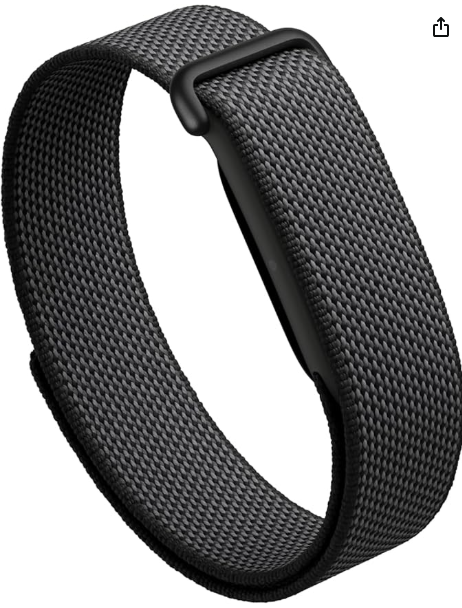
Consumer wearables are built and validated primarily to detect relative change over time in one person — are you sleeping more restlessly this week than last month, is your resting heart rate trending up or down over a season — not to produce an absolute number precise enough for clinical use. A tracker that says you got "6 hours 42 minutes of sleep, 18% deep sleep" is giving you a genuinely useful trend data point even if that exact figure isn't lab-accurate; the mistake is treating the precise number as a fact rather than as an estimate that's consistent enough with itself over time to be useful for comparison. If you're shopping for a device to generate that trend data in the first place, we looked at one screenless option in our Google Fitbit Air review.
Consistency matters more than accuracy for this use case
If a tracker is off by a consistent amount — say it always reads slightly optimistic on deep sleep — that's actually fine for spotting trends, because the bias is the same every night. What would actually undermine the tracker's usefulness is inconsistent error: accurate on Monday, wildly off on Tuesday for no clear reason. That kind of inconsistency shows up more with movement-heavy metrics (steps, calories during a specific unusual activity) than with metrics based on steadier signals (resting heart rate, sleep duration), which is part of why trackers tend to be more reliable for the latter.
Where trackers are weakest
Sleep stage classification (light/deep/REM) is estimated from motion and heart-rate patterns, not the brain-wave monitoring a real sleep lab uses, so stage-by-stage numbers are the least reliable part of most consumer sleep trackers even though they're often displayed with the most visual polish. Calorie-burn estimates during unusual or high-intensity activity are similarly rough — a device calibrated mostly on walking and running data can misjudge weightlifting, swimming, or cycling by a wide margin. Treat these specific numbers as very rough estimates rather than as something to budget a diet around.
A more useful way to use the data
- Look at your own week-over-week and month-over-month trend lines rather than any single night or day's absolute number.
- Weight steadier metrics (resting heart rate, sleep duration, weekly activity minutes) more heavily than noisier ones (sleep stages, calorie burn during atypical activity).
- Treat a sudden, unexplained shift in a trend as a prompt to pay attention to how you actually feel — not as a number to chase or fix directly.
- If something feels persistently wrong beyond what the tracker shows, talk to a professional rather than trying to self-diagnose from the app.
The takeaway
A tracker is a reasonably good motivational and pattern-spotting tool and a poor stand-in for medical measurement. Both things can be true at once, and knowing which job you're actually asking it to do is the difference between getting real value out of one and being quietly misled by a precise-looking number that was never meant to carry that much weight. If sleep is specifically what the tracker's flagging as a problem, pairing that trend data with an actual fix matters more than the score itself — our white noise machine vs. weighted blanket comparison covers two of the more common ones.